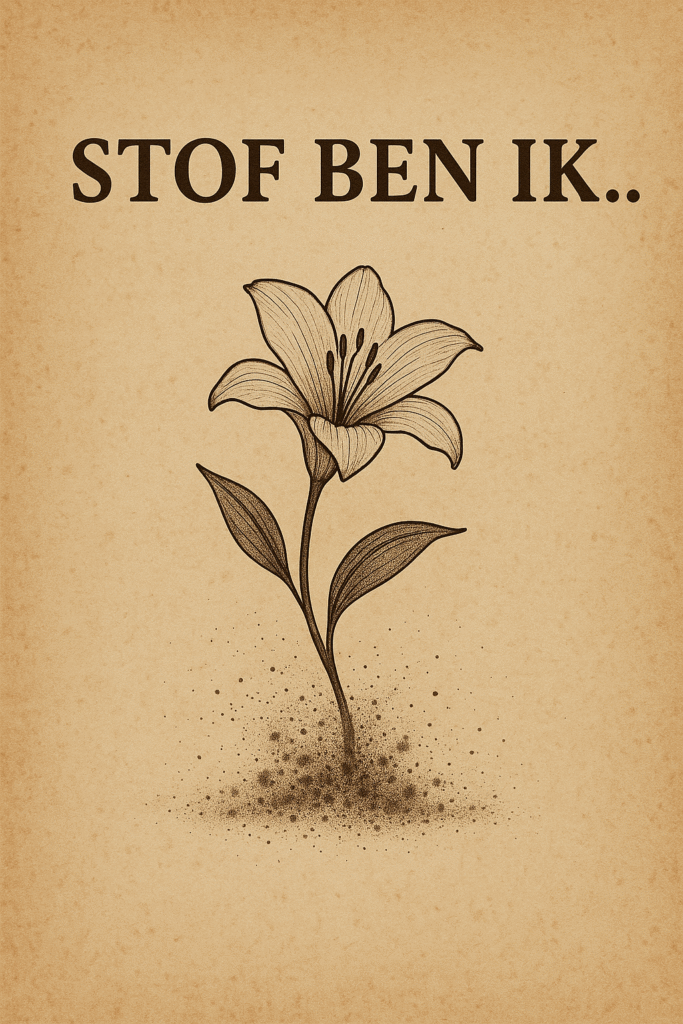
The older I get, the more naturally I return to my roots. Bible verses often surface—texts I have carried with me in the golden little box in my heart for as long as I can remember. Now that I have left behind the phase of resisting the strictly Christian God of my youth, I can listen to them with a sense of wonder. The words reach me differently. I pick them up, look at them anew, blow the dust off, and explore what they mean to me now. It feels almost familiar—engaging in exegesis, just as I learned more than sixty years ago during my theology studies. And then it can suddenly happen that an old word opens itself to me in a completely new way
“I want to show how this unfolds by using a text that is often spoken at Christian funerals, a text that used to make me even sadder than I already was.”
Dust you are, and to dust you shall return.… (Genesis 3 vers 19)
“The word that is translated here as ‘dust’,” עָפָר, ʿafarhas so much more meaning than simply ‘dust.’ It is a soft, granular word, like soil slipping through your fingers, and it refers both to everything that is fine and perishable, and to the primordial matter from which human beings are made.”
In this word a circular movement becomes visible: what arises from the earth returns to it. ʿAfar is the dust of life itself—perishable and yet rooted, a tiny grain and at the same time cosmic. It stands for the subtle boundary, which is no boundary at all, between form and formlessness. Form is emptiness, emptiness is form.
The timeless paradox becomes visible in this. In everyday life ʿafar stands for something small and unassuming: the dust under your feet, the dry earth that rises in the wind. And in the larger scheme, it is the substance from which humans are formed and to which they return. Everything that turns to dust disintegrates and crumbles. This points to the fragility of human existence. And at the same time, that disintegration is not disappearance. It is a movement back into the raw material of lifeʿAfar is perishable and imperishable—it is a continuous movement that never ceases. Beginning and end touch each other. One could say thatʿafar is a boundary word. It refers both to what perishes and to what carries the perishable. In this simple word, the entire rhythm of life and death is contained.
When I connectʿafar with the metaphor of The Flower, I see the movement between the heart and the petals, between exhaling and inhaling, between silence and form, between what is and what crumbles. The heart is the space that is neither born nor dies, the breathless depth of presence. The petals are the movements of life: thinking, feeling, acting, desiring, joy, pain. They are precious, changeable, fragile. They are the unique expression of my essence in this world. When I look through this lens, there appears” ʿafar as the material of the petals themselves: the perishable body-mind, the patterns that form and dissolve again. It is precisely these forms that eventually return to the substance from which they emerged.
And the heart—the silent core of The Flower—returns nowhere and disintegrates nowhere. It is the imperishable element that breathes through all layers. In the language of Genesis, it is ‘the breath of life’ that is breathed into dust. ʿafar In the language of The Flower, it is the silent, boundless love that takes form. This is the endless paradox of non-duality—neither one nor two—beyond our comprehension: the petals are perishable, and that which animates them is not.
Zo belichaamt ʿafar Thus ʿafar embodies the memory of my origin. Every pattern that appears—a thought, an emotion, an action—is made of the same material as the mountains, the fields, the stardust. Everything is a form of the same source without a source, inexhaustible beyond any form. In this awareness, I can see the end of my life as a return into a movement that has always been greater than I am—greater in the past, in the present, and in what is yet to come. Yes, I am dust, and to dust I shall return…